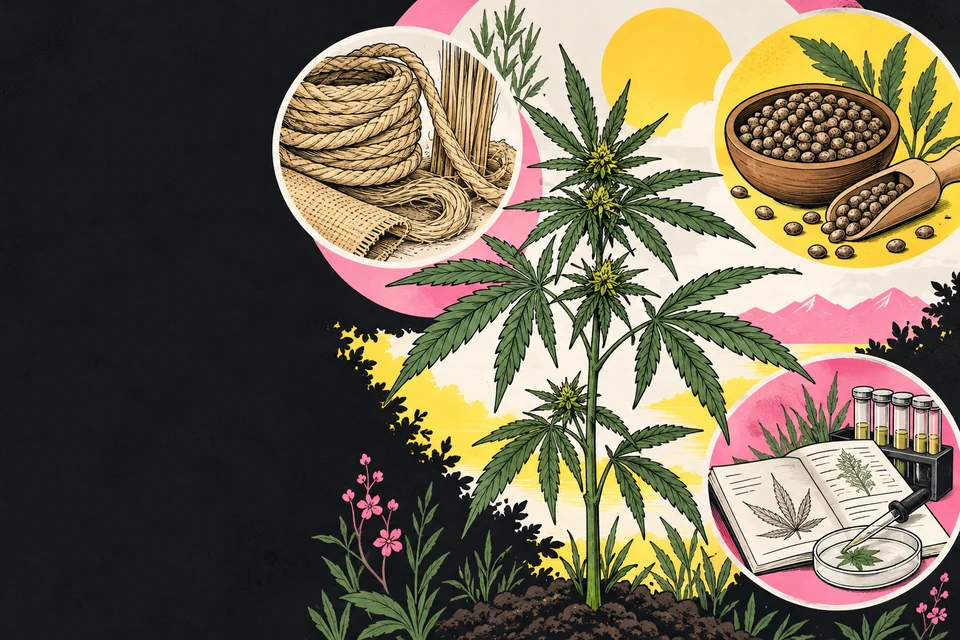
Four distinctions to make before comparing hemp and cannabis
Hemp belongs within Cannabis. A useful comparison separates four questions: botanical classification, intended uses, chemical composition and legal definitions. Leaf shape or a cultivar name alone cannot establish THC content. Legal thresholds also require a country, date and product category. The tables and examples below keep these questions distinct instead of treating one jurisdiction’s threshold as a universal rule. Kew · Plants of the World Online: Cannabis sativa Smith et al. · chemical diversity, PLOS ONE (2022) Health Canada · validation of cannabis analytical methods
The short answer needs context
Hemp belongs within Cannabis rather than forming a completely separate botanical group. “Hemp” may describe crops selected for fibre or seed uses, or a category defined by law. In everyday conversation, “cannabis” is also often used more narrowly for material associated with flowers or intoxicating effects. To compare the terms accurately, first identify the language being used: botany, chemistry, industry or law.
Rather than diagnosing two plants from leaf silhouettes, this guide separates shared biology, different uses and the documents needed for particular conclusions. By the end, “CBD-rich,” “0.2%” and “0.3%” should each lead to a different question. Legal classification of a raw material is not automatically authorization of every product made from it.
Kew’s taxonomy: an accepted species, not a marketing category
Kew’s Plants of the World Online accepts Cannabis sativa L. in Cannabaceae and treats Cannabis indica and Cannabis ruderalis as synonyms in its system. Cannabis sativa was published as a name in 1753. This is a taxonomic treatment, not a statement that every scholar uses an identical classification or that every country’s legislation follows Kew’s terminology. Kew · Plants of the World Online: Cannabis sativa
A scientific name identifies a taxon within a classification. A catalogue cultivar, competition category and product name perform other jobs. “Sativa” on an award table should therefore be interpreted through the event’s rules, not automatically through a species description. Recognizing that distinction prevents confusion before a laboratory number even enters the discussion.
Different uses are real, but not absolute biological walls
A 2019 account from Thailand’s Highland Research and Development Institute describes fibre and other hemp uses, reminding readers that human interest in the plant extends beyond flowers. Selection and processing priorities change the characteristics an industry values: fibre properties, seed ingredients or chemical composition. One intended use does not make the plant’s other structures disappear. สวพส. · การใช้ประโยชน์กัญชง (2019)
| Perspective | What matters | Appropriate evidence |
|---|---|---|
| Botany | Taxonomic placement | Taxonomic sources and specimens |
| Fibre/seed use | Fitness for an intended use | Quality data and material specifications |
| Chemistry | Which compounds and how much | Specimen-bound analytical results |
| Law | Classification of this material or product | Instrument, jurisdiction and effective date |
Why a leaf is not a compliance test
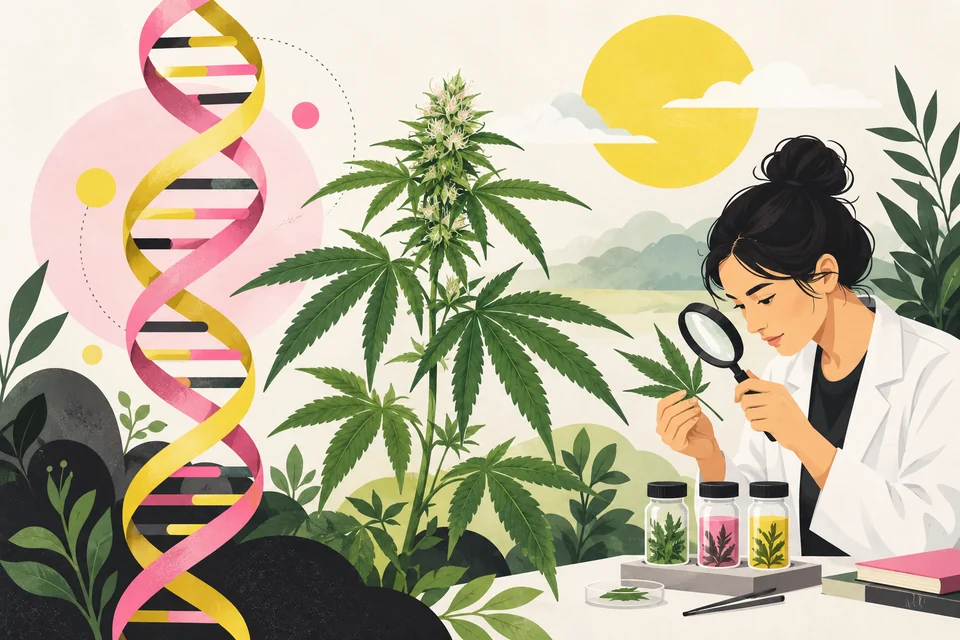
Public explainers often introduce the comparison through leaf and plant form, as in Thailand’s science-learning centre’s educational material. An introductory illustration cannot replace specimen identification, chemical measurement or a legal determination. Visual observation is useful when its scope is explicit, rather than when resemblance is treated as a test result. ศูนย์ส่งเสริมและพัฒนาการเรียนรู้ทางวิทยาศาสตร์ · กัญชงและกัญชา
With an unverified plant photograph, we can describe visible leaf form or other observable features. We should not infer legal status, absence of THC or suitability for treatment. Separating phenotype from genotype and chemotype explains why one observed characteristic cannot answer every question about the plant.
Chemical dominance describes a relationship
THC means tetrahydrocannabinol; CBD means cannabidiol. They are different compounds. THC-dominant describes dominance relative to CBD under the definition being used, not a species or therapeutic conclusion. Genotype concerns inherited genetic information, phenotype concerns observable or measurable characteristics, and chemotype concerns a chemical-composition pattern.
Smith and colleagues’ 2022 PLOS ONE study analysed a large flower dataset from several US states using THC-dominant, balanced THC:CBD and CBD-dominant groupings. It also found inconsistent alignment between commercial labels and chemical composition. The central distinction here is that classification by ratio is different from classification by percentage concentration. Smith et al. · chemical diversity, PLOS ONE (2022)
Consider a fictional unit-reading exercise: A has 10% CBD and 1% THC; B has 1% CBD and 0.1% THC. Both have a CBD:THC ratio of 10:1, but their THC concentrations differ tenfold. “CBD-dominant” alone cannot answer whether a concentration limit is met. These numbers are hypothetical, not BUDS test results or product-selection advice.
A number needs a specimen and a method
Health Canada’s analytical guidance emphasizes methods appropriate to the measurement. A report should therefore be read with the analyte, units, method and detection or quantification limits together. “Not detected” is not necessarily zero, and one specimen’s result does not describe every batch bearing the same name. Health Canada · validation of cannabis analytical methods
Ask which plant part or product was tested, whether the basis is dry weight or something else, and whether the result reports delta-9 THC or a defined total. Our lab-report guide follows sample identifiers and methods in more detail. These questions come before comparing a number with legislation.
Percentages and mg/kg are not interchangeable rules
Percent by mass and milligrams per kilogram can be converted on the same basis: 0.3% by mass equals 3,000 mg/kg. That arithmetic does not make two rules interchangeable. If one instrument concerns a crop variety and another a food oil, they still regulate different objects for different purposes.
Attach four fields to any limit: the substances counted, the material tested, the measurement basis, and the jurisdiction and date. Without them, “below the limit” is incomplete. If the number is a CBD:THC ratio, stop before making a concentration claim; the preceding example shows exactly why.
Thailand: the 0.2% provision concerns extracts
Thailand’s 2022 Category 5 narcotics notification lists extracts in that category, with an exception for extracts containing no more than 0.2% THC by weight under specified authorization and domestically grown-plant conditions, alongside an exception for extracts from seeds of domestically grown cannabis or hemp. That number is not a botanical boundary between hemp and cannabis, a CBD threshold or permission to sell every resulting product. ราชกิจจาฯ · ยาเสพติดประเภท 5 พ.ศ. 2565 (สำเนา CAAT)
The 2025 controlled-herb notification concerns cannabis specifically in the flowering part, a framework distinct from the narcotics listing of extracts. The second licensing ministerial regulation of 2026 adds conditions for relevant activities. Legal interpretation therefore needs the plant part, activity and applicable authorization, not a single sentence declaring the whole plant universally legal or illegal. The flowering-part notification also ties sales to individuals under its specified exception to a medical prescription, rather than granting general sales rights through a 0.2% figure. ราชกิจจาฯ · สมุนไพรควบคุม พ.ศ. 2568 ราชกิจจาฯ · ใบอนุญาตสมุนไพรควบคุม ฉบับที่ 2 พ.ศ. 2569
United States: a changing definition needs a date
The federal definition introduced in 2018, reflected in 7 USC 1639o, uses no more than 0.3% delta-9 THC on a dry-weight basis within its stated scope. This is not a natural boundary in the plant or a universal international standard. The material definition also does not replace food, medicine or state-level requirements. United States Code · 7 USC 1639o, 2023 edition
Public Law 119-37, section 781, enacted in 2025, changes the framework toward total tetrahydrocannabinols including THCA and excludes certain product categories. Public Law 119-103, section 2019, subsequently defers most changes until 11 December 2026, while specified provisions concerning cannabinoids that Cannabis sativa cannot naturally produce retain a 12 November 2026 date. Both dates are future dates at this article’s 11 October cutoff; the revised regime should not be presented as already fully applicable. US Public Law 119-37 · section 781 (2025) US Public Law 119-103 · section 2019 (2026)
Europe: agricultural and food requirements sit on different layers
Article 4(4) of Regulation 2021/2115 uses a THC content not exceeding 0.3% as a condition concerning hemp varieties and eligible agricultural hectares under the CAP. It is not automatic permission to sell flowers, extracts or foods throughout the EU. Understanding the function of a threshold matters as much as remembering its number. EU Regulation 2021/2115 · Article 4(4)
For foods, Regulation 2023/915 gives limits of 3.0 mg/kg for hemp seeds and specified seed-derived products, and 7.5 mg/kg for hemp seed oil, using delta-9 THC equivalents: Δ9-THC + 0.877 × Δ9-THCA, with THCA meaning tetrahydrocannabinolic acid. The units and regulated materials differ from the CAP framework. Treating 0.3% as the limit for every food would answer the wrong question. EU Regulation 2023/915 · Annex I, section 2.6
From plant to food or medicine, another evidence step is needed
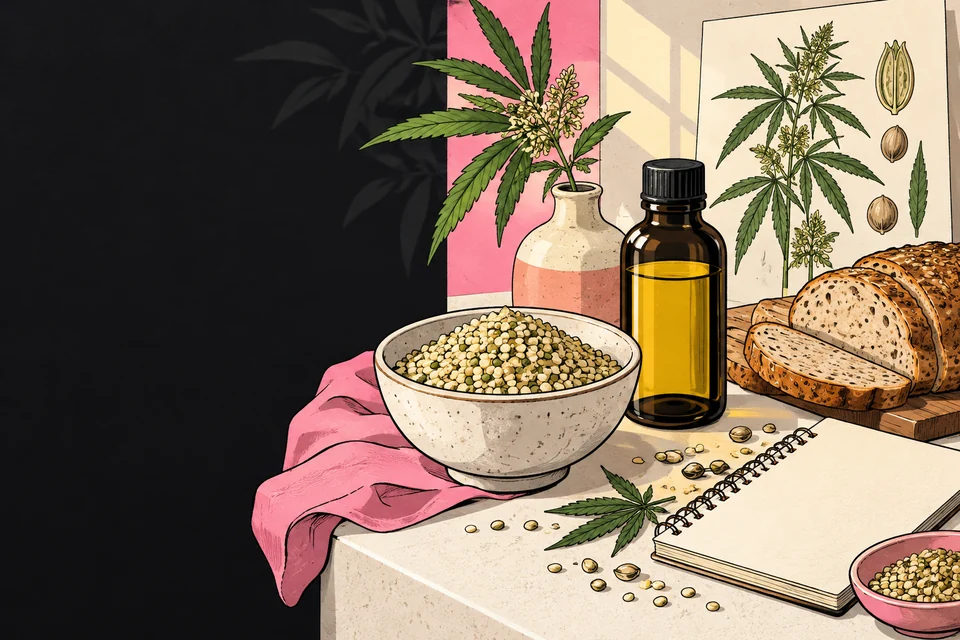
The US FDA’s responses to three hemp-seed ingredient GRAS notices concern specified ingredients under proposed uses. They illustrate product-level assessment rather than a decision based on the plant name alone. Our cannabis-and-food article separates seeds, seed oil and extracts and connects them with the relevant Thai documents. US FDA · hemp-seed ingredients
In medicine, being CBD-dominant or meeting a hemp definition is not evidence of efficacy. The clinical question follows the studied product, participants, administration and outcomes. The histories of Charlotte’s Web, Cannatonic and Bedrocan show the journey from recognizable names to more specific clinical questions.
A record that lets professionals ask the same question
Imagine receiving a document that says only “hemp extract: compliant.” The record is incomplete. Ask for the material description, batch, provenance, analytes and units, matching results, method and destination-specific criterion. A CBD:THC ratio of 10:1 still omits concentrations. A raw-ingredient report is not a finished-food report. This fictional exercise identifies missing information; it does not pass or fail an actual product.
A laboratory needs the specimen and method. A researcher needs an explicit definition. A clinician needs a product and patient-relevant evidence. A business also needs the requirements for its activity and destination market. Professional communication is not a matter of more impressive vocabulary. It means preventing different participants from using the same word for different things.
The most useful distinction is a precise question
Hemp and cannabis share biology, while intended uses, specimen composition and legal classification can differ substantially. A name, leaf shape or cannabinoid ratio cannot answer all of those layers. Strong knowledge starts by identifying the question and choosing evidence that actually addresses it.
Our cannabis history places naming and plant use in a longer story. Return to Thai policy sources when the date or activity changes. This comparison was checked through 11 October 2026 and explains bounded examples; it is not a product-specific authorization for transport, production or sale.
Sources & further reading
- Kew · Plants of the World Online: Cannabis sativa ↗
- Smith et al. · chemical diversity, PLOS ONE (2022) ↗
- United States Code · 7 USC 1639o, 2023 edition ↗
- US Public Law 119-37 · section 781 (2025) ↗
- US Public Law 119-103 · section 2019 (2026) ↗
- EU Regulation 2021/2115 · Article 4(4) ↗
- EU Regulation 2023/915 · Annex I, section 2.6 ↗
- ราชกิจจาฯ · ยาเสพติดประเภท 5 พ.ศ. 2565 (สำเนา CAAT) ↗
- ราชกิจจาฯ · สมุนไพรควบคุม พ.ศ. 2568 ↗
- ราชกิจจาฯ · ใบอนุญาตสมุนไพรควบคุม ฉบับที่ 2 พ.ศ. 2569 ↗
- ศูนย์ส่งเสริมและพัฒนาการเรียนรู้ทางวิทยาศาสตร์ · กัญชงและกัญชา ↗
- US FDA · hemp-seed ingredients ↗
- Health Canada · validation of cannabis analytical methods ↗
- สวพส. · การใช้ประโยชน์กัญชง (2019) ↗