Are hemp seeds, hemp seed oil and CBD the same ingredient?
Hemp seeds, hemp seed oil and CBD extract are different ingredients. Seed oil is not CBD oil, and a leaf symbol does not identify a product’s composition. Start with the plant part, ingredient list and relevant testing, then check the requirements for that product and country. This distinction connects the article’s culinary histories with its discussion of nutrition, labels and safety. US FDA · cannabis-derived food FAQ US FDA · three hemp-seed GRAS notices (2018)
One plant name, very different foods
A hemp-seed soup at Christmas, bread containing seed protein and a sweet containing an extract may all be placed under “cannabis food.” Their ingredients, purposes and risks can be very different. A leaf symbol on packaging is therefore a poor starting point on its own. The useful questions are which plant part was used, what ingredient was produced and what the manufacturer is claiming.
This article moves from culinary history to ingredients and labels. It is not a recipe for intoxication. The aim is to read menus, news and products with enough precision to distinguish a tradition from a therapeutic claim, and a natural origin from a demonstrated standard of quality. Good food writing can preserve pleasure and cultural detail while still asking exactly what is on the plate.
Siemieniotka: small seeds in a ceremonial meal
Poland’s agricultural ministry records siemieniotka, also called konopiotka, as a Silesian hemp-seed soup with barley served at Christmas Eve meals. It entered the traditional-food register in 2006. The revealing detail is the seed’s place in a special meal and regional memory, not an assumption of intoxication. That history should not be rewritten as a precedent for every modern THC-containing product. Polish Ministry of Agriculture · siemieniotka
The register describes a pale greenish-beige soup with roasted barley and a slightly bitter taste. It looks quite different from the brightly coloured sweets often associated with cannabis products today. Here the food’s identity rests in colour, texture and an occasion for gathering. The 2006 date records registration, not the first time anyone prepared the dish. Polish Ministry of Agriculture · siemieniotka
Festival food is not one national recipe
Interview-based research in NCHMCT’s Indian Food Heritage describes bhang-containing thandai in some Hindu festive settings in western Uttar Pradesh, while noting family objections to intoxication. The account belongs to the groups and region studied, not every kitchen in India. Neither the name thandai nor the occasion of Holi guarantees cannabis in every glass. NCHMCT · Indian Food Heritage, chapter 16
A socially meaningful food can have different formulations and attitudes toward ingredients within the same community. Our account of cannabis and ritual therefore includes both participation and disagreement. For someone reading a menu today, the most useful information remains the actual ingredient list, rather than a festival name or a leaf illustration.
Seeds, seed oil, protein and extracts
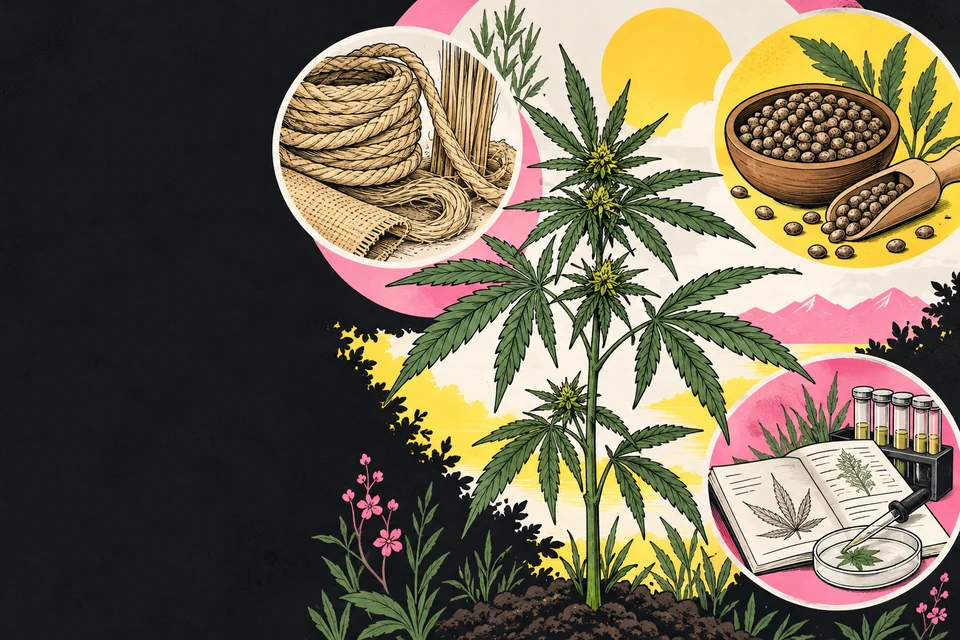
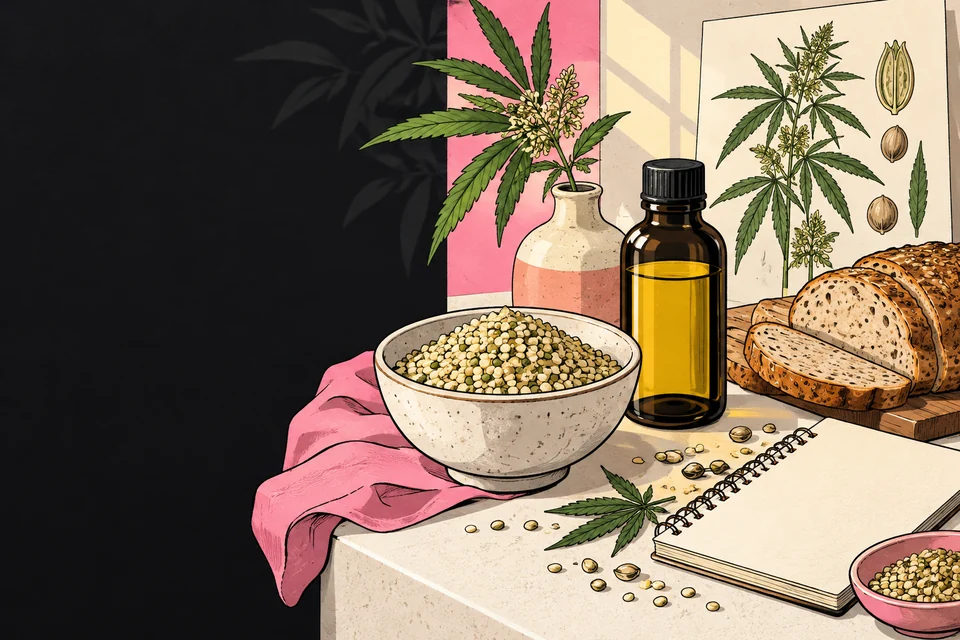
Hemp seeds are a different food ingredient from flowers or extracts. The US FDA explains that seeds do not naturally contain THC or CBD, although trace material can arrive through contact with other plant parts during handling. “The seed is not a cannabinoid source in the same way as flower” and “food ingredients still require contamination control” can both be true. US FDA · cannabis-derived food FAQ
| Label term | What it describes | Do not assume |
|---|---|---|
| Hulled hemp seed | Dehulled seed ingredient | It is flower or CBD extract |
| Hemp seed oil | Oil obtained from seeds | The leaf image establishes a CBD content |
| Hemp seed protein | Seed-derived protein under a specified process | Every form has the same composition and standard |
| CBD extract | An extract requiring composition and product-status information | It is simply seed oil or automatically an approved medicine |
Read nutrition without turning food into medicine
Thailand’s Highland Research and Development Institute discusses hemp seeds as a source of plant protein and fats, opening a food perspective beyond the flower. For a finished product, use that formulation’s nutrition panel. Dehulled seeds, separated oil and concentrated protein are not nutritionally identical ingredients simply because all began with seeds. สวพส. · เมล็ดกัญชง (2024)
Compare like with like, such as the same weight or serving basis, and read energy, fat, protein and other ingredients together. Adding seeds does not remove the sugar or fat elsewhere in a recipe. “Plant-based” is not proof of treatment benefit. The whole food deserves attention: an attractive ingredient cannot answer every question about the finished formulation.
What the US GRAS record actually says
In 2018 the FDA responded to three GRAS notices for hulled hemp seed, seed-derived protein and seed oil, with no questions about the notifier’s conclusions under the proposed uses and specifications. That response is not approval of every cannabis food or CBD formulation. It also does not create Thai marketing authorization. US FDA · three hemp-seed GRAS notices (2018)
The reading lesson is to preserve the object of the decision: which ingredient, under which conditions, for which intended uses. Shortening that to “the FDA endorsed cannabis in food” turns a bounded record into a different claim. A direct source link is useful because it lets the reader recover the boundary, not because the presence of an official logo settles every related question.
Thailand: different documents for different ingredients
Thai Ministry of Public Health Notification 425 of 2021 addresses hemp seeds, seed oil, protein and foods containing those ingredients. Notification 437 of 2022 amended provisions including standards for different protein forms and ingredient records. Read the base notification with its amendment rather than treating an early infographic as the final authority. อย. · ประกาศฉบับที่ 425 พ.ศ. 2564 สธ. · เมล็ดกัญชงและผลิตภัณฑ์ ฉบับที่ 437
Foods containing specified plant parts, such as leaves without attached tops or inflorescences under Notification 427’s definition, have their own framework: 438 amends 427. Foods containing CBD extracts are addressed separately, with 439 amending 429. Those distinctions matter more than applying one THC number to everything. These documents are used here to explain the structure, not to assess or authorize a particular commercial recipe. สธ. · อาหารจากส่วนพืช ฉบับที่ 427 ข้อ 2 สธ. · อาหารจากส่วนของกัญชา/กัญชง ฉบับที่ 438 สธ. · อาหารที่มีสารสกัด CBD ฉบับที่ 439
The Thai Food Division’s examples help readers recognize product categories. Our guide to Thai policy sources distinguishes news, legal instruments and effective dates. A business then needs product-specific checks covering classification, formulation, premises, labels and current requirements with the responsible authority. An educational article is not a substitute for that assessment. อย. · ตัวอย่างผลิตภัณฑ์อาหารจากเมล็ดกัญชง
CBD in food: conditions matter
EFSA’s 2026 assessment sets a provisional intake level under restricted conditions for food supplements containing CBD of at least 98% purity, without nanoparticles, with a production process deemed safe and genotoxicity excluded, while retaining data gaps. It could not establish safety for people under 25, pregnant or lactating people, or those taking medication. This is not blanket authorization of CBD in foods or reassurance that unrestricted consumption is safe. EFSA · provisional CBD assessment, February 2026
Explaining an assessment does not require turning this article into a dosing chart. The goal is to understand the decision, not prescribe an amount. The same named compound can be assessed differently in a medicine, food or cosmetic. Our medical-cannabis histories explain why treatment evidence remains tied to particular products and indications.
A European example: food limits are a separate question
EU Regulation 2023/915 sets contaminant limits for seed ingredients and seed oil in milligrams per kilogram. An agricultural 0.3% threshold cannot replace them. Regulation 2026/1828 adds provisions for leaves intended for infusion and prepared infusions, but applies from 1 January 2027. At this article’s 11 October 2026 research cutoff, that application date is still in the future. EU · food contaminants Regulation 2023/915 EU · Regulation 2026/1828, applies January 2027
This example shows why an update needs both the adoption date and the application date. A country name and the word “legal,” without a product category or time reference, can turn a real announcement into mistimed advice. Our hemp-versus-cannabis guide separates the botanical, chemical and legal questions in more detail.
Two fictional labels to think through
Fictional label A says “100% hemp seed oil.” Fictional label B says “vegetable oil with CBD extract.” Even if their leaf graphics match, A identifies an oil source and B identifies an added extract. The follow-up questions differ. Both still require actual producer, batch, labelling and product-status information. A botanical image cannot supply missing documentation.
If a test report is supplied, check whether it describes the ingredient or finished food, whether the batch matches and whether the units concern a kilogram, serving or whole container. Our lab-report guide explains those distinctions. These are fictional reading exercises, not products tested or endorsed by BUDS.
THC-containing food must not be mistaken for ordinary snacks
The CDC explains that THC-containing edibles can have delayed and unexpectedly prolonged effects, contributing to repeated consumption and poisoning. Accidental ingestion can seriously harm children. Keep such products clearly identified, locked away and separate from ordinary food, beyond children and pets. That risk should neither be assigned indiscriminately to compliant seed foods nor concealed by familiar-looking snack packaging. CDC · cannabis and poisoning
If a child may have eaten a THC-containing product, contact a clinician or poison centre immediately rather than waiting for symptoms. The FDA emphasizes prompt help because symptoms can be delayed and products may resemble ordinary snacks. Keep the packaging and available information for the professionals assessing the situation. US FDA · accidental ingestion of THC foods by children
For severe symptoms such as breathing difficulty or unconsciousness, seek emergency help; Thailand’s emergency medical number is 1669. Retain packaging information for the responding professionals. This article does not propose treating an adverse reaction with other foods or substances. Calling something food is not assurance that it cannot impair driving or other safety-critical activity. โรงพยาบาลระนอง · ระบบการแพทย์ฉุกเฉิน 1669
Good food knowledge begins with ingredient clarity
Cannabis and food offer lively stories about family meals, ingredients, nutrition and quality systems. Enjoyment does not require blurring their names. The practical outcome is being able to distinguish seeds, seed oil, protein, other plant parts and extracts, then read histories, labels and requirements appropriate to each.
For Thailand’s industry, credible food storytelling can begin with describable flavour, disclosed ingredients and checkable quality. The food-history section of our main documentary supplies wider cultural context; this article supplies questions that can be used immediately. Documents were checked through 11 October 2026, and current rules must be rechecked before assessing an actual product.
Sources & further reading
- Polish Ministry of Agriculture · siemieniotka ↗
- NCHMCT · Indian Food Heritage, chapter 16 ↗
- สวพส. · เมล็ดกัญชง (2024) ↗
- US FDA · three hemp-seed GRAS notices (2018) ↗
- US FDA · cannabis-derived food FAQ ↗
- อย. · ประกาศฉบับที่ 425 พ.ศ. 2564 ↗
- สธ. · เมล็ดกัญชงและผลิตภัณฑ์ ฉบับที่ 437 ↗
- สธ. · อาหารจากส่วนของกัญชา/กัญชง ฉบับที่ 438 ↗
- สธ. · อาหารที่มีสารสกัด CBD ฉบับที่ 439 ↗
- อย. · ตัวอย่างผลิตภัณฑ์อาหารจากเมล็ดกัญชง ↗
- EFSA · provisional CBD assessment, February 2026 ↗
- EU · food contaminants Regulation 2023/915 ↗
- EU · Regulation 2026/1828, applies January 2027 ↗
- CDC · cannabis and poisoning ↗
- โรงพยาบาลระนอง · ระบบการแพทย์ฉุกเฉิน 1669 ↗
- US FDA · accidental ingestion of THC foods by children ↗
- สธ. · อาหารจากส่วนพืช ฉบับที่ 427 ข้อ 2 ↗