What evidence connects cannabis with ritual?
Evidence for cannabis in ritual includes archaeological residues, historical texts and accounts from living communities. Jirzankal and Tel Arad help establish what materials were present; selected Indian traditions and Rastafari also require attention to practitioners’ own contexts. These sources do not establish one universal ceremony or a single shared origin. The article distinguishes physical evidence from interpretations of its meaning. Ren et al. · Science Advances (2019) Arie, Rosen & Namdar · Tel Aviv (2020) Rastafari Indigenous Village · community description
A small residue can change a large historical question
A scorched wooden vessel tells us that fire touched it. By itself, it does not identify who used it, what burned or what the participants believed. The study of cannabis and ritual begins in that gap. Archaeologists examine context, chemists examine residues, historians read texts and ethnographers listen to communities. The picture becomes clearer when those methods work together without being asked to answer one another’s questions.
The journey runs through the Pamir, the fortress shrine at Tel Arad, Herodotus’ account, selected Indian traditions and Rastafari in Jamaica. It is not a proven transmission route for one universal ceremony. A plant can acquire different meanings in different societies. Similarity alone does not establish a shared origin, and a present-day custom cannot simply be projected back onto an ancient object.
Object, residue, context and meaning
| Evidence | Can address | Does not establish alone |
|---|---|---|
| Object context | A cemetery, shrine or domestic setting | Participants’ experiences |
| Chemical analysis | Detected compounds under specified methods | Prayers or religious identity |
| Ancient text | What an author recorded | Chemical verification of every description |
| Ethnographic fieldwork | Meanings described by participants | Identical beliefs across all communities |
This is not a ranking in which a person’s voice matters less than a laboratory result. It separates functions. A practitioner’s account may be the best evidence for what an activity means to that person; identifying a chemical requires another method. A complete interpretation preserves both material evidence and human voices.
The Pamir: a high-altitude cemetery and scorched vessels
Jirzankal, also called Ji’erzankale, is a cemetery in the eastern Pamir, in present-day Xinjiang. Shen and colleagues’ 2015 study examined wooden vessels, implements and a musical instrument alongside the cemetery’s stone arrangements. The authors discussed the significance of fire. Suggestions about religious influence should remain interpretations rather than a definitive religious label for everyone buried there. Shen et al. · PLOS ONE (2015)
The wooden finds include dishes, arrow shafts and fire-making implements. Researchers identified different woods selected for different tasks, including Betula for dishes. These details reveal material knowledge and craft before cannabis enters the headline. The cemetery preserves several dimensions of community life, rather than existing only as a container for evidence of one substance. Shen et al. · PLOS ONE (2015)
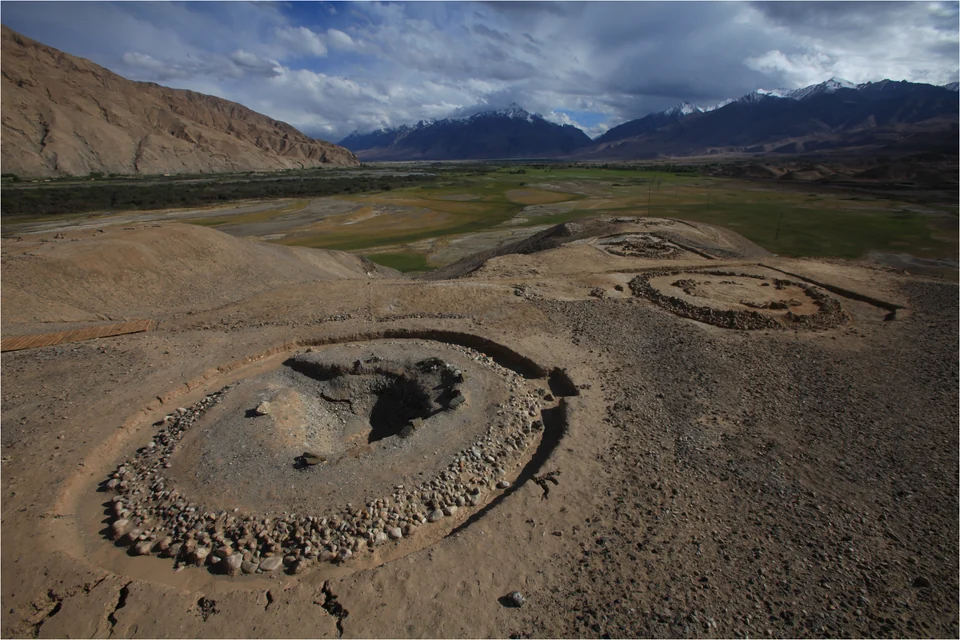
The site photograph above is reused under CC BY 4.0, with its authors and source article credited beneath it. Web preparation changes only dimensions and file metadata, not the objects or context shown. Creative Commons · CC BY 4.0
A 2016 study compared strontium ratios in tooth enamel with a local reference and identified some individuals whose values did not match growing up locally. This makes the Pamir a meeting place rather than simply an isolated mountain backdrop. Isotopes do not identify ethnicity, religion or who introduced cannabis. This is another method applied to the same cemetery, not an independent discovery at another site. Wang et al. · Scientific Reports (2016)
Silk fragments and an angular harp belong to the material context discussed alongside human mobility in the strontium study. Exchange is therefore connected to objects rather than invoked as an empty label. None requires us to invent a musician’s or merchant’s biography for a particular burial. The surviving things and the unresolved questions already make the high-altitude world tangible. Wang et al. · Scientific Reports (2016)
What the 2019 residue study did—and did not—measure
Ren and colleagues reported in 2019 that CBN occurred on the charred inner surfaces of most tested wooden vessels, while exterior control samples lacked cannabinoids. CBN can arise from THC degradation. The authors interpreted the findings as cannabis burning in a funerary context around 500 BCE and suggested material richer in THC than typical wild plants. This is an inference from surviving residues, not a direct measurement of an ancient flower’s original THC percentage. Ren et al. · Science Advances (2019)
Selection, cultivation, gathering and environmental influences remain separate questions from residue detection. Naming a modern cultivar would skip several evidential steps. So would inventing prayers, sensory experiences or the participants’ exact emotions. The discovery remains remarkable without filling those spaces: an object can preserve a trace of human action while leaving much of its meaning unresolved.
Herodotus: read the surrounding passage
Histories IV.73–75 describes Scythian purification after burial: Herodotus records hemp associated with heated stones under a covering. The translation uses “seed,” but this is an ancient account, not chemical confirmation of the material. It should not be overlaid on burning within Jirzankal’s cemetery and treated as proof of an identical ceremony. Herodotus · Histories IV.73 University of Texas · Herodotus IV.74–75
The University of Texas presentation of IV.74–75 includes hemp in clothing and mentions plants growing spontaneously or being sown. Its scholarly introduction also notes uncertainty about whether Herodotus personally visited the northern Black Sea communities or relied on reports. “He recorded” is more accurate than “he proved.” Ancient terminology for plant material should likewise not be silently converted into modern chemical analysis. University of Texas · Herodotus IV.74–75
Tel Arad: two altars, different residues
Arie, Rosen and Namdar’s 2020 study analysed residues from two stone altars in the Judahite fortress shrine at Tel Arad, dating to roughly the eighth century BCE. THC, CBD and CBN were identified on the smaller altar; the larger carried markers of frankincense. The authors interpreted the findings within a ritual setting. The analysis does not recover prayers, attendance or each participant’s experience. Arie, Rosen & Namdar · Tel Aviv (2020)
Tel Arad’s context is older than Jirzankal even though the chemical study appeared later. Publication dates and the ages of objects belong on different timelines. Evidence from one shrine also does not establish cannabis use by every Judahite community or at the Temple in Jerusalem. Keeping a conclusion tied to its location makes the history more accurate without making the discovery less significant.
India: listen to disagreement within a tradition
Sadhus are religious ascetics belonging to diverse traditions. Daniela Bevilacqua’s fieldwork makes disagreement concrete: Jogi Baba describes ganja through prasad, while Ishnath of the Nath tradition regards intoxication as incompatible with yogic mental discipline. Cannabis accompanies some satsang gatherings—conversations about spiritual and religious matters—but does not define every sadhu’s life. Daniela Bevilacqua · Harvard CSWR (2026)
Shiva is a Hindu deity. Prasad refers to an offering returned and shared as a blessing, rather than to a particular cannabis food. Understanding these terms helps show that a practitioner speaking about a plant may also be describing a relationship with the sacred. That is a different vocabulary from a chemist’s or retailer’s. Harvard Religion and Public Life · offerings and prasad
Stuart Ray Sarbacker’s 2026 textual scholarship describes relationships with yoga that include acceptance, restriction and prohibition. The relevant questions are which period, text and tradition are being discussed. An old plant term cannot automatically be equated with a modern identification, and sacred meaning is not clinical evidence of improved meditation or health. Stuart Ray Sarbacker · Journal of Contemplative Studies (2026)
Holi and thandai: a festival is larger than one ingredient
In this context bhang names a cannabis preparation for eating or drinking; thandai is a chilled nut-and-spice beverage. The terms are not synonyms. Holi includes many other foods and activities. Establishing the vocabulary first lets us follow the family and festival story without guessing ingredients. Daniela Bevilacqua · Harvard CSWR (2026) Incredible India · Holi
NCHMCT’s Indian Food Heritage includes interview-based research on festive food in Hindu communities of western Uttar Pradesh. It describes bhang in thandai in some settings and notes that some families disapprove because of intoxication. That evidence belongs to the communities and research described, not to every Indian household or region. NCHMCT · Indian Food Heritage, chapter 16 (2018)
The festival-food study also describes community bonfires before the day of colours, singing, temple decoration and foods such as the filled sweet gujiya. Family disagreements about bhang occur within that larger meal and gathering. People are not all present because of one ingredient. This restores proportion to a festival sometimes reduced to a story about intoxication. NCHMCT · Indian Food Heritage, chapter 16 (2018)
India’s tourism ministry presents Holi through spring, colours, food and social connection, including a nut-and-spice thandai. The drink’s name does not therefore guarantee cannabis content. Our cannabis-and-food article distinguishes seeds, seed oil and products containing active extracts, without turning festival history into an intoxicating recipe. Incredible India · Holi
Rastafari: religion, community and the right to self-description
Rastafari emerged in 1930s Jamaica as figures including Leonard Percival Howell and Robert Hinds connected Haile Selassie I of Ethiopia with sacred history and Black dignity. Peyton White’s archival research describes finding a Selassie postcard in records of Howell’s 1934 prosecution. An object once entered as evidence against a man can also preserve the political and religious imagination the authorities sought to contain. Peyton White · UT Austin archival field report (2026)
This background gives claims about ganja a context larger than access to a substance. Participants are also arguing over who gets to define their lives and beliefs. State records are not necessarily neutral voices: reading a surveillance archive requires attention both to what it preserves and to why officials chose to preserve it. The historical question includes the observer as well as the observed.
Jamaica’s Ministry of Justice discussed Rastafari claims for recognition of sacramental ganja and religious freedom in a 2014 reform statement. The document makes visible a relationship between drug control, state power and what a community regards as sacred. The history is not merely a history of a substance and its consumers. Jamaica Ministry of Justice · law reform statement (2014)
Jamaica Information Service describes changes effective on 15 April 2015 allowing Rastafari adherents to smoke ganja for sacramental purposes in registered Rastafari places of worship. This is a historical milestone in acknowledging religious context, not a current travel guide or a statement that every form of cannabis activity is permitted. Jamaica Information Service · Dangerous Drugs Act facts
Look beyond the smoke
Reasoning names conversations with spiritual and political significance. Benjamin Bean’s Jamaican fieldwork account describes elders bringing biblical passages into discussion of contemporary questions. Agreement is not automatic. Learning appears through listening, disagreement and interpretation, rather than through a picture of people sharing one undifferentiated state of mind. Benjamin Bean · UCLA fieldwork reflection (2015)
Rastafari Indigenous Village describes its projects through drum-making, Ital food, gardens and the transmission of knowledge. Its activity descriptions also discuss sacred herb and reasoning. These are the voices of that particular community, not a substitute for every Rastafari perspective or clinical evidence for commercial wellness claims. Rastafari Indigenous Village · community projects Rastafari Indigenous Village · community description
In the same village, Cardolisa Wray’s kitchen describes Ital through “vital” and fresh plant foods, while King Toto and Sugah pass on drum-making. “Way of life” becomes visible through people and work: a kitchen, a garden, hands making an instrument and knowledge being passed along. This is the community’s own description, not one compulsory diet or lifestyle for all Rastafari. Rastafari Indigenous Village · people and kitchen
If the story stops at someone smoking, it misses the work, relationships, food and care for memory that sustain community life. Images of people and ceremonies also require appropriate rights and context. A brand or visitor’s expectation should not become the template into which a community’s identity is forced.
Two timelines and questions worth leaving open
| Case | Context | Research or record |
|---|---|---|
| Tel Arad | Approximately eighth century BCE | Residue study, 2020 |
| Jirzankal | Around 500 BCE | Objects, 2015; residues, 2019 |
| Herodotus | Ancient account in Histories | Text, translation and context |
| Living traditions | Community- and period-specific | Fieldwork, documents and community accounts |
What connects these cases is not proof of one universal cannabis rite. It is the human capacity to give plants meaning through death, faith, friendship and everyday life. Our cannabis history provides a wider account of early evidence, while BUDS’ community section makes room for people’s stories beyond products. Sources for this article were checked through 11 October 2026.
Sources & further reading
- Ren et al. · Science Advances (2019) ↗
- Shen et al. · PLOS ONE (2015) ↗
- Wang et al. · Scientific Reports (2016) ↗
- Herodotus · Histories IV.73 ↗
- University of Texas · Herodotus IV.74–75 ↗
- Arie, Rosen & Namdar · Tel Aviv (2020) ↗
- Daniela Bevilacqua · Harvard CSWR (2026) ↗
- Stuart Ray Sarbacker · Journal of Contemplative Studies (2026) ↗
- NCHMCT · Indian Food Heritage, chapter 16 (2018) ↗
- Incredible India · Holi ↗
- Jamaica Ministry of Justice · law reform statement (2014) ↗
- Jamaica Information Service · Dangerous Drugs Act facts ↗
- Rastafari Indigenous Village · community projects ↗
- Rastafari Indigenous Village · community description ↗
- Peyton White · UT Austin archival field report (2026) ↗
- Benjamin Bean · UCLA fieldwork reflection (2015) ↗
- Rastafari Indigenous Village · people and kitchen ↗
- Harvard Religion and Public Life · offerings and prasad ↗
- Creative Commons · CC BY 4.0 ↗